Showing posts with label Citrus. Show all posts

Thursday, November 8, 2012

Citrus. It's not just important for pirates.

Indie Farms' Kumquat

Like making Russian Tea around the holidays? What about fresh squeezed orange juice for those family breakfasts? Planning to ruin some kids' Christmases by stuffing their stockings with Clementines?


That's right, I said it. Kids don't get excited about an orange in their stockings. I don't even celebrate Christmas and I know that.

But you still do it, don't you?

Right on. I'd do it too. Because I love Clementines and, hey, if someone's going to fill a sock with something for me, I'd rather it be sweet little citrus rather than big sweaty foot, am I right?

Who are you trying to fool with fruit in the stocking?

Anyway, I've gotten off track. What I wanted to tell you guys was that, if you want to make sure to have a big sweet (or tart) citrus harvest this winter in NorCal, now's the time to feed your trees.

They're blossoming, setting fruit and getting ready to go to the winter show right now and they need a snack before they go.

The timing and schedule for feeding citrus vary depending on who you talk to, but in the test garden, we feed our potted and planted citrus on a monthly basis with an organic citrus food like Dr. Earth's Fruit Tree Fertilizer. Then we reap a mighty harvest all winter long without fear of the scurvy that plagued our seafaring ancestors.

Arrrrr! Avast ye matey!

What?

Yeah - just making sure you're still paying attention.

Feed me, Seymour.
Feeding your trees is easy:
  1. Measure out the recommended amount (based on the size of the tree's trunk) into a garden-only measuring cup.
  2. Pour it around the base of the tree.
  3. Mix it in to the surface of the soil by hand.
  4. Water it in well.
  5. Walk away for a month. (But still water when the soil is dry to the touch)
This will keep your fruit trees well fed so that, in return, they can make you some food. And fodder for Christmas stockings, much needed adult beverages, holiday gifts (that also happen to be adult beverages) and remedies for cold and flu symptoms.

Want more citrus recipes? Check it.

Medicinal produce that does not require a special card.

Thursday, September 27, 2012

Fall is good times


Sure, we get all tomato-sad at the end of the summer when the weather starts to cool off and our big beefy summer crops start heading toward the compost bin, but there's still good stuff to come out of this time of year.

In fact, there's tons.

Nasturtium are suddenly, GAME ON.
We've been psychos about pinching back the basil and, FOR ONCE, it's paying off in a good fall crop.
The Solly Beiler cucumbers are all about the cooler mornings and hot afternoons.

This year, we're having what's amounting to an Indian Summer. In the sense that it's unseasonably warm and predicted to stay that way for the month of October.

This means a few things:
  1. Some of your summer crops will pick up where they started to leave off a few weeks ago when the temperatures took their normal fall drop in production when the weather *started* to cool off. They'll get all, "YAY! Heat!" and probably try to pump out a new round of blossoms or even crops.
  2. You can get in a late crop of fall vegetables before our first frost shows up sometime around November 1. 
In the case of the test garden, we've sown a fall crop of bush beans that *should* be ready to harvest by mid to late October, we're bringing in lots of nasturtium and sunflower bouquets and we're watching the cucumbers, basil and watermelons spring back to life for one last shot at joining a meal.

Bush Beans acting all promising.
We never get tired of nasturtium bouquets. Or smooching moose.
That should be a bar name, "The Smooching Moose." Right? Right.
This Moon and Stars watermelon is a little late to the game, but we're letting it think it's still summer.

It also means that some of our sorta crappy looking summer plants that really should have been pulled by now are getting a few more weeks to do *something* before they're summarily chucked into the bin.

And, for this Jaune Flamme tomato that *something* is joining us for lunch today.

This is also a really good time to do some fall planting of perennial vegetables, pruning of herbs and feeding.


Artichokes, like this Green Globe guy, do well planted as younglings in the fall. They'll usually produce a small harvest in early spring and then be big and bushy for the next spring. We plant ours in the perennial landscaping beds since they don't need to be replanted every year like most of your vegetables do.


Feverfew, a herb used a lot for treating headaches (by regularly chewing a few leaves), appreciates an early fall pruning to remove old growth so that it can put on lovely healthy new growth. It self-seeds in our area (Zone 9), so if you have it growing this fall, you'll have some new seedlings cropping up in spring. If you don't have it growing already, it's a great seed to start in spring once the soil warms up.

This Meyer Lemon has seen some rough years, but is bounding back after its recent feast.

Growing citrus? Lemons, limes, kumquats, oranges, clementines, whatever - they're all prepping fruit for the California winter right now and would appreciate a little snack to get on their way. Generally speaking, citrus plants need to be fed three times a year - late winter (February), late spring (May) and late summer (September) - to produce reliable fruit crops.  We like Gardner & Bloome's Fruit Tree Fertilizer because it's organic, readily available (Yay! No hunting around!) and the application amounts are easy to calculate (Yay! Because we suck at math!).

So, we're not getting bummed about the forthcoming putting to bed of the summer garden because we're too busy growing fall crops and prepping for winter planting.


Friday, June 15, 2012

Broccoli noodle salad

Broccoli Noodle Salad
Recipe by moi

Ingredients
Broccoli, 1 head cut into florets
1 large carrot, shredded
1 handful of string beans, halved, tips removed (optional)
1 serving of rice vermicelli noodles
4 t fish sauce
2 T fresh lime juice
1 clove garlic, minced
2 T sugar
1/2 t garlic chili sauce

Noodle salad
Prepare vermicelli according to package directions and don't forget to rinse with cold water and set aside to drain well.
 
Steam broccoli, carrots and beans for 5-7 minutes or until tender crisp and not limp. Rinse in cold water and set aside.

Sauce
Whisk together fish sauce, lime juice, garlic, sugar and chili sauce in a large bowl. Then dump in noodles and steamed vegetables. Toss until noodles and vegs are completely coated with the sauce and allow to stand briefly for the flavors to get all mingley.

Eat with chopsticks if you're feeling exotic or with your feet if you're feeling grody yet coordinated.

Enjoy.

Monday, June 4, 2012

Fresh Veg Spring Rolls with dipping sauces

Fresh Veg Spring Rolls with Dipping Sauces & Asian Coleslaw
 
Serves 2
Ingredients
Spring rolls
1 serving of rice vermicelli
3 small carrots, julienned
3 green onions, julienned
Bunch of cilantro, rinsed
Bunch of mint leaves, rinsed
8 Lettuce leaves, rinsed

Dipping sauce
2 T fresh lime juice
1 clove garlic, minced
2 T sugar
1/2 t garlic chili sauce
3 T hoisin sauce
1 t finely chopped peanuts

To make
Spring rolls
Prepare vermicelli according to package directions and don't forget to rinse with cold water and set aside to drain well.

Fill a large shallow bowl with warm water. Dip one wrapper into the hot water for a second to soften. Lay it flat, add a lettuce leaf and then fill with a few strips each of carrots and onion, some vermicelli, a spring of cilantro and a few mint leaves leaving about 2 inches of open space on either side of your veg pile. Fold uncovered sides inward, then tightly roll the wrapper. You don't have to tuck in the ends. That's a dirty, dirty rumor.

Do all this over and over until you run out of stuff. You'll have about 8 rolls. 

Dipping sauce
Mix everything except the peanuts and hoisin together in one bowl. Then mix the hoisin and peanuts in another bowl. DONE!

Friday, April 20, 2012

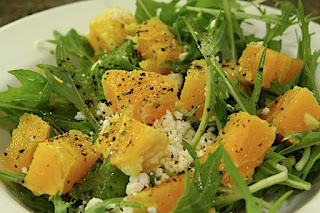
Citrus salad with goat cheese

Have you met mizuna? It's a frilly little salad green found often in Asian dishes. It also does well cooked into hot dishes.

If you have a tajine, you should become friends with mizuna as they play nice together.

Meanwhile, this is not a tajine recipe, nor an Asian recipe. Just something thrown together from the contents of the garden on a spring evening.

Citrus salad with goat cheese

Serves 2
Ingredients
Bunch of mizuna
2 oranges, peeled, cut into small wedges
1/4 cup of crumbled goat cheese
Salt
Pepper
Olive oil

To make:
Rinse the mizuna really well, making sure to knock off any remnant dirt from the farm. Trim off excess stalk at the end. Fill a couple bowls with the mizuna, add goat cheese and oranges, pour on a bit of olive oil, a bit of salt and a healthy grind of pepper.

I like a lot of pepper on this. It's good with the sweet oranges and smoky goat cheese. 

Happy feasting.